

Introduction to Lean Manufacturing
The management model carried out by a company to organize its processes has a very strategic importance, having in mind that the most important objetive must be final customer satisfaction by offering a product or service obtained with the highest quality possible and minimizing the cost and lead time.
The organization of production started with the management systems that emerged early 20th century with Henry Ford (traditional systems) based on mass production to obtain economies of scale in which the operations and activities that belong to a production process are optimized are optimized indepently.
Lean Manufacturing arose in Toyota related with production, but it can be applied to all types of areas (sales, finance, management...). Lean Manufacturing tries to optimize the added value for the customer, and the main difference with the traditional systems is that it's based on processes management, and not operations looking for optimizations in an independent way (as traditionl systems do).
Lean production can be defined as a management model that has the main objetive of maximizing the added value for the final customer, by minimizing the waste in the system and using the less resources possible, this is, only the ones strictly needed.
Customer will be the main objective of the business activity
In order to get business excellence, it must be avoided all the ideas present in companies managed with traditional systems related to productivity, growth, financial results, and make a change of mindset and center all in the main objective, the customer.
In a company with a Lean approach, paying attention to the customer will be the objective ot the business activity, and it will be named value to all what customer expects and wishes, so all the production processes will be designed in order to add value.
What is value in Lean?
Organizations that are "Lean" should be able to deliver all that customer expects, with the quantity and quality required, and at precisely the right time. We should wonder, does it add value to my customer?.
It will be considered customer, the final customer and also an internal customer, that would be the process that goes afterwarda, and both will have their specific requirements and definition of value. Each process will need to fix their objectives based on what customer requests and expects.
Value must be present in all the activities:
- Marketing and sales What does the customer desire really?
- Producción: Are all the activities in my production process valued by my customer without adding additional cost or lead time delivery?
- Calidad: Does the product have the required quality to get the customer satisfaction?
What is the value stream?
In addition to product design and services adapted to customer needs, it will be necessary to deliver them in a fast without using unneccessary resources, grouping the activities that build the value stream for the customer.
This value stream will cover various procesesses and department. Let's assume an example of production of a blender, which consist of an electric motor which will be manufactured in company A, and another components which will be manufactured and assembled afterwards in company B. Below you can see an small scheme of the value stream since the first process at company A to the final customer.

In order to have the right consistency, the value stream needs to be analyzed totally and globally, and avoid that each department/process is centered only in the part that corresponds to them acting like an independent being. This is very common in traditional organizations, in which there is a very poor communication between departments that are strongly connected such us commercial and production department, which usually make actions without taking into account each other. It's also very frequent to observe that each department has its own objectives, and that usually work one against the other, which is logically incorrect.
Is the organization oriented towards the value stream?
Let's assume an organisational structure as the one shown below and let's compare the information flow for a problem in a "traditional" company and a company with a lean approach.

Let's suppose a simple process since the receipt of an order until the manufacturing.
In a traditional organization which is characterized by being inflexible, the structures are too rigid and with a lot of vertical hierarchical levels and the information flows almost exclusively vertically, this is from boss to subordinated by orders and fromm subordinated to boss by reports and consultations. Therefore, talking about the example just mentioned "Sales" department will receive the order and it will be transmitted to "Commercial Management" and they will also transmit it to "Top Management" and information will flow downwards hierarchically going through "Commercial Management", afterwards to "Production and Planning" to finish with "Production Department Workforce", which will manufacture physically the order requested. In all this information flow we can observe the inefficiency of the communication which prior getting up to Production Workforce (where the value is added) it goes through five hierarchical levels, going up to go down afterwards.
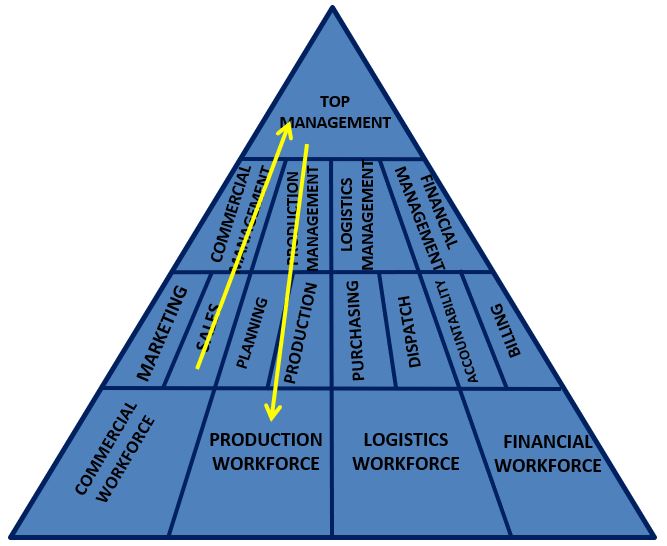
In companies with a lean approach, its required a fast and direct flow and the have a flat horizontal organizational structure which offer much more flexibility, with the less hierarchy possible to ensure a correct performance. In this case, related to our example, here "Sales" department will make order reception an they will communicate to "Planning and Production" from which the information will go down to "Production Workforce" where the product will be produced. As we can clearly see, the information flow has only gone horizontally between two hierarchies, so it's clear the more efficiency of information flow compared to traditional companies.

Processes and value stream
The key objective in which we need to focus the effort is in generating added value to the product when it is going though all the different process required.
We need to make the exercise of trying to use customer perspective and wonder to ourselves about the different activities of the production processes:
- Is the activity being performed adding value that would be valorated by the customer?
- If I were a customer, would I pay for this activity?
In case of a NO for both questions, the activity that we are studying is a waste. Lean Methodology tries to identify and eliminate them as fas as possible, which leads to efficiency and competitiveness.
Every process add value that is consumed by next process. This way, we can find appart from the final customer, internal customers. Customer will be the process that goes after the current one.
We should not forget that in this value chain, other areas such us marketing, services, etc, also participate and all of them together add value to the final product that needs to satisfy final customer needs.
Below we can see a graphic of the value chain and the processes that integrate it. The set of all these links will determine the total added value.