

Types of Plant Layout
The way in which the processes are distributed in a production plant is key to achieve our main goal, adding value to our customer.
Below we explain main types of plant layout, oriented to process, product, cellular or fixed position.
Process-oriented layout
In this layout distribution the activities are organized in a functional way, without any relationship with the product, which will be moved from one activity to next one in each operation.
Let's imagine a production process which consist of the following operations:
- Clipping
- Screwing
- Welding
- Painting
A process-oriented layout would be the following:

As we can see, in this layout we would have a raw material/components warehouse, and after moving components required for clipping operation, they would wait in the functional area of "Clipping". Afterwards, when clipping of all the batch is finished and stored, it would be sent to functional area of "Screwing" and this operation would be realized for all the batch. Later, this stock would be moved to "Welding" area until finishing the complete batch and then, it would be shipped to our final customer.
This kind of layout is still used a lot in traditional companies because it has a lot of flexibility and variability in the products processed, however, a lot of stock is going to be accumulated between the different operations in order to minimize the transports of material.
Advantages of process-oriented layout
The advantages of process-oriented layout will be the following:
- Variety and flexibility in the type of product: in this layout machines will be universal to be able to work with large batches of different typology of products. We need to take into account that usually, these type of machines will require skilled labour.
- Possibility of amortizing the elements used: as the machines will be universal, different types of products will be processed by them so the degree of utilization will be usually higher than other types of plant layout.
Disadvantages of process-oriented layout
The disadvantages of this type of layout will be the following:
- Processing time very long: complete lead time of the process will be very long as we are working with large batches. It's worth to be taken into account the waiting time of the material until the batch is completed as well as the waiting time in front of the functional area because it could happen that there's a queue of products to be processed.
- High amount of waste: it will be explained in detail in the post dedicated to "Mudas", but as explained previously with this process-oriented layout there's a lot of waiting time, long distances for transports, container transfers and more things which makes that it has not the desired efficiency. To summarize, with this layout a lot of activities are created which don't add value to the final customer.
Product-oriented layout
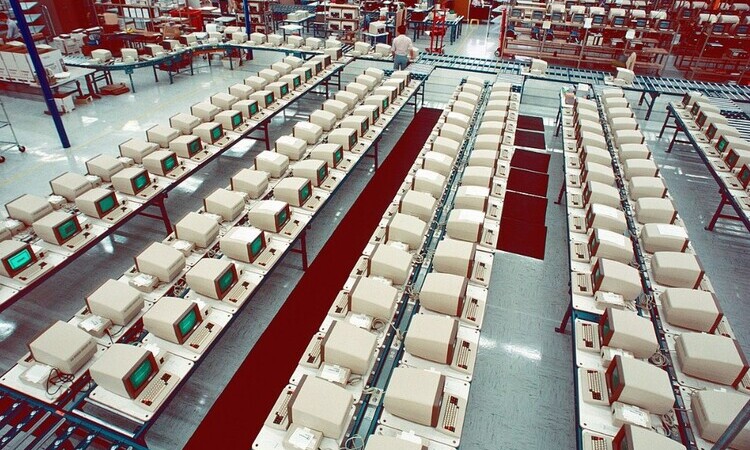
In this type of layout, which is antagonistic to the one explained previously, the activities will be distributed one next to each other, organized based on the sequence that needs to be made to manufacture the product. This is the clear example that we can see in typical assembly lines. With this distribution the manufacturing leadtime, transports and cost are minimized but it requires a high homogeneity in the product manufactured in the line as well as a great activities synchronization.
Vamos a seguir con el ejemplo mostrado anteriormente, pero en este caso con una distribución orientada al flujo:

It can be observed that in this type of layout, the material is transported from the warehouse to the "Clipping" station, and from there, the material is processed unit by unit, passing through all the phases until the batch is completed and sent to the final customer.
Advantages of flow-oriented or product-oriented layout:
Among the advantages of working with a flow-oriented layout are the following:
- Minimization of movement: It can be observed that the material will travel far fewer meters than in the previous case, and we must keep in mind that movement is waste.
- Reduction of stock levels: Since the material is processed unit by unit in each activity, there is the added advantage of lower operating costs. As the stock is non-existent, it does not need to be managed, moved, or require storage space.
- Short lead times: Since the material does not have to wait to enter each activity, as was the case with process-oriented layouts, lead times are reduced.
Disadvantages of flow-oriented or product-oriented layout:
- Low flexibility: The production must be very homogeneous because, with dedicated machines for a specific product, other products that are not as similar will not be produced with the same efficiency.
- High production volumes required: To ensure that the dedicated machines are not underutilized and can be amortized, high production volumes are necessary.
Flow-oriented layouts are typical in plants with advanced designs, where material moves in small batches, with equipment very close to each other and dedicated to the process, minimizing lead time and stock. From a lean perspective, the downside of this layout is the lack of flexibility, which can be addressed with cellular layouts or flexible cells.
Cellular layout or flexible cells:
A complete section has been dedicated to cellular layouts in plants (see "Cellular Manufacturing and U-Shapped Cells"), but as a first idea, we should understand that this is the layout sought in lean manufacturing, aiming to combine the flexibility of process-oriented layouts with the efficiency achieved with product-oriented layouts.
These cells will group the operations that constitute the processes, which will be managed as a whole, unlike traditional management (usually in process-oriented layouts), where each operation is managed independently.
Fixed-position layout:
This is where, due to the dimensions and/or weight of the product being manufactured, the product remains in a fixed position, and the production workers move to where the product is located.
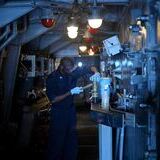
This layout is used for the manufacturing of airplanes or ships.