



Poka-yokes: Non-contact presence sensors for components
Non-contact presence sensors are those that activate or deactivate the electrical mechanism to which they are attached depending on whether or not they detect the presence of an object within a certain radius of action, without the need for physical contact with the object.
In this post we will describe the most commonly used non-contact sensors for detecting the presence of components, i.e., they will serve as a poka-yoke to detect a missing component when making an assembly.
Inductive Sensors
These sensors are used to detect ferrous materials, i.e. metals containing iron. Some inductive sensors are also capable of detecting some non-ferrous metals such as aluminum, brass and copper. Below we can see what an industrial inductive sensor looks like.
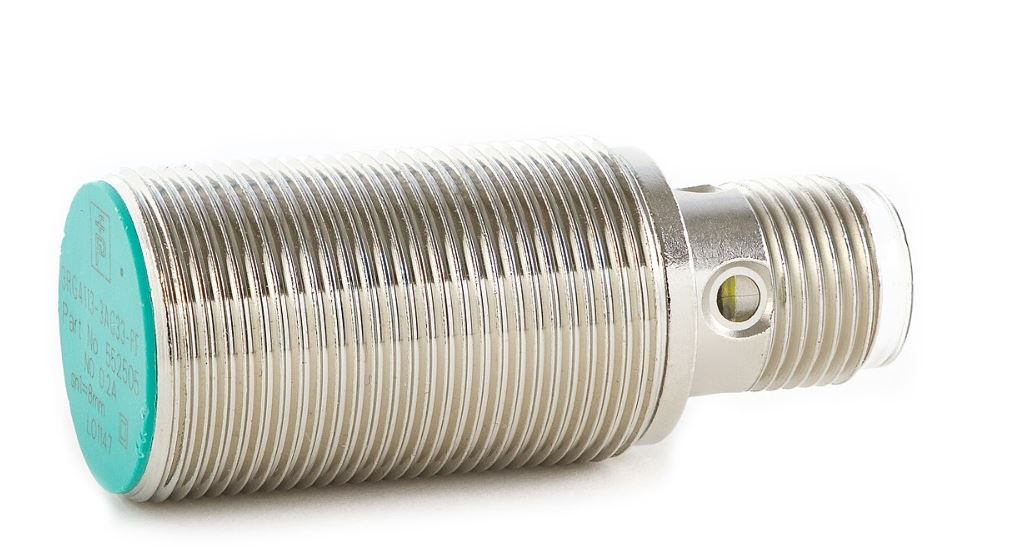
The use of these sensors, as mentioned above, will be reserved for assemblies that have ferrous metal components such as nuts, bolts, washers, etc...
How does an inductive sensor work?
Let's define the operation of the inductive sensor in a very summarized way.
- The inductive sensor, once installed and with its correct power supply, creates an electromagnetic field that is emitted from the active surface of its front side.

- The fact of putting a metal near that front side will weaken the electromagnetic field (as there is an eddy current and energy transfer to the metal object) and the sensor, by detecting this change in the field, will be able to recognize the presence or distance to the metal object.

Detection range of the inductive sensor
Typically the sensing ranges of this type of sensor are from fractions of a millimeter to approximately 60 millimeters. This detection range will depend on the winding used in the sensor design to create the magnetic field.
Advantages of inductive sensors
- They can work in adverse environmental conditions: Since they only detect metal, it does not matter if these sensors are covered with dust or oil, they will still be just as functional. They will also withstand vibrations and shocks.
- Installation is very simple.
- It has a very high sensitivity (only reserved for ferrous metals or those mentioned above).
- It has a long service life, as it has no moving parts.
Disadvantages of inductive sensors
- They are limited to detect only metals (mostly ferrous), so it will not work for other materials.
- Sometimes, due to magnetic fields, errors in measurement accuracy may occur.
Capacitive sensors
Capacitive sensors are very similar to inductive sensors with the difference that they are able to detect any type of material.
Therefore, if we need to control the presence of a plastic component, for example, this type of sensor would be valid.
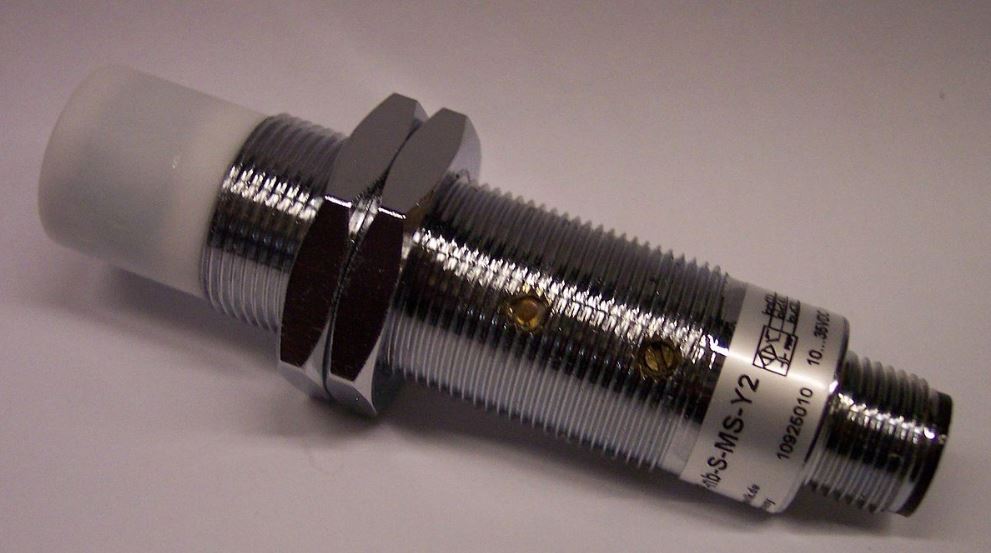
How does a capacitive sensor work?
The operation is similar to that of inductive sensors, but in this case an electric (electrostatic) field is created rather than an electromagnetic field.
- The capacitive sensor, after being installed, generates an electrostatic field (through a capacitor/condenser and an oscillator) on the active surface of its front side.

- When a material is placed nearby, a change in the capacitance of the capacitor occurs, which causes a change in the electrostatic field. This change is detected and interpreted by the sensor.

Detection range of the capacitive sensor
Normally the detection range of this type of sensor is between 3 and 60 millimeters.
Many capacitive sensors have a potentiometer inside to adjust their sensitivity.
Advantages of capacitive sensors
- As mentioned, they can be used for the detection of non-metallic components.
- Its sensitivity is adjustable.
- It is easy to install.
- They are low cost.
Disadvantages of capacitive sensors
- Adverse environmental conditions (temperature, humidity, etc.) will affect their performance.
- They are less accurate than inductive sensors.
Photoelectric Sensors
Photoelectric sensors or photocells use a beam of light to detect the presence of objects.
They are a good alternative to inductive sensors if we need to detect over long distances or if the material to be detected is not metallic.
How does a photoelectric sensor work and what types are there?
Photoelectric sensors or photocells consist of a transmitter and a receiver. Their operation, simply explained, is as follows:
- The transmitter emits a beam of light (it can be in the visible or infrared - non-visible spectrum).
- The receiver, through a photosensitive component, measures the intensity of the light beam from the transmitter. Therefore, if there is an object, the light intensity will vary and will be interpreted by the sensor as an object.
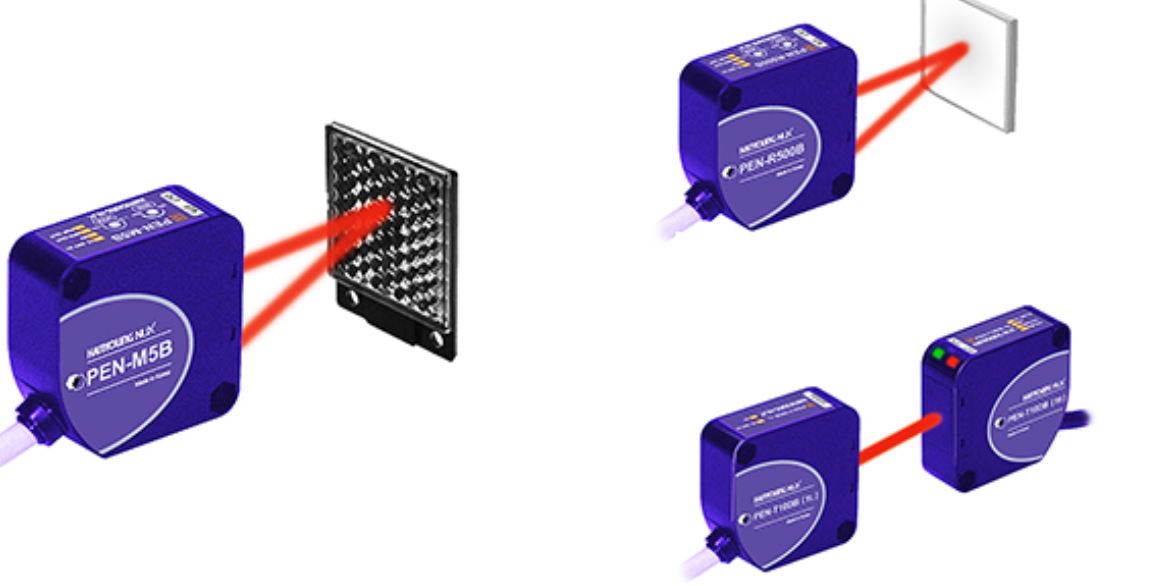
There are three types of photoelectric sensors: diffused, through-beam and retroreflective.
Diffuse-reflective Sensors
In this type of photocell, transmitter and receiver are in the same housing, and basically the intensity of the light reflected (diffuse reflection) by the object to be detected is measured.

The installation time of these photocells is shorter than the others, as only one housing has to be wired, but on the other hand, they have a worse detection accuracy and it sometimes takes some time to get a proper adjustment (sometimes differences in color or planes inside the object can make this adjustment difficult). The detection range is also smaller than the other options.
Through-beam Sensors
In this case transmitter and receiver are separated and the principle of operation is based on the fact that when the object passes, the light beam is interrupted.

These photocells have a long range (up to 60 meters), high accuracy and are easier to adjust, since color differences in the object do not affect the detection. As a disadvantage they would need a longer installation time, as there are two housings, and a precise alignment between them has to be performed to avoid false positives. Another disadvantage would be the fact that they would have difficulty detecting translucent objects, since the light beam would pass through them and reach the receiver, giving a confusing signal.
Retroreflective Sensors
Aquí, al igual que las reflectivas, transmisor y receptor están en la misma carcasa, pero hay un elemento más, el reflector, encargado de reflejar el haz de luz. Cuando hay un objeto, el haz de luz no llega al reflector y por lo tanto no es reflejado, evidenciando la presencia del "obstáculo". Son capaces de detectar también a largas distancias parecidas a las de las fotocélulas de barrera.
Here, like the diffuse-reflective ones, transmitter and receiver are in the same housing, but there is one more element, the reflector, in charge of reflecting the light beam. When there is an object, the light beam does not reach the reflector and therefore is not reflected, showing the presence of the "obstacle". They are also capable of detecting at long distances similar to those of barrier photocells.